26 June 2026 · Turchina Group · 10 min read
Investment Advisory in Turkey for Chinese Family Offices: 2026 Guide
Investment advisory in Turkey gives Chinese family offices market strategy, independent due diligence, and execution across citizenship, real estate, funds, and M&A.
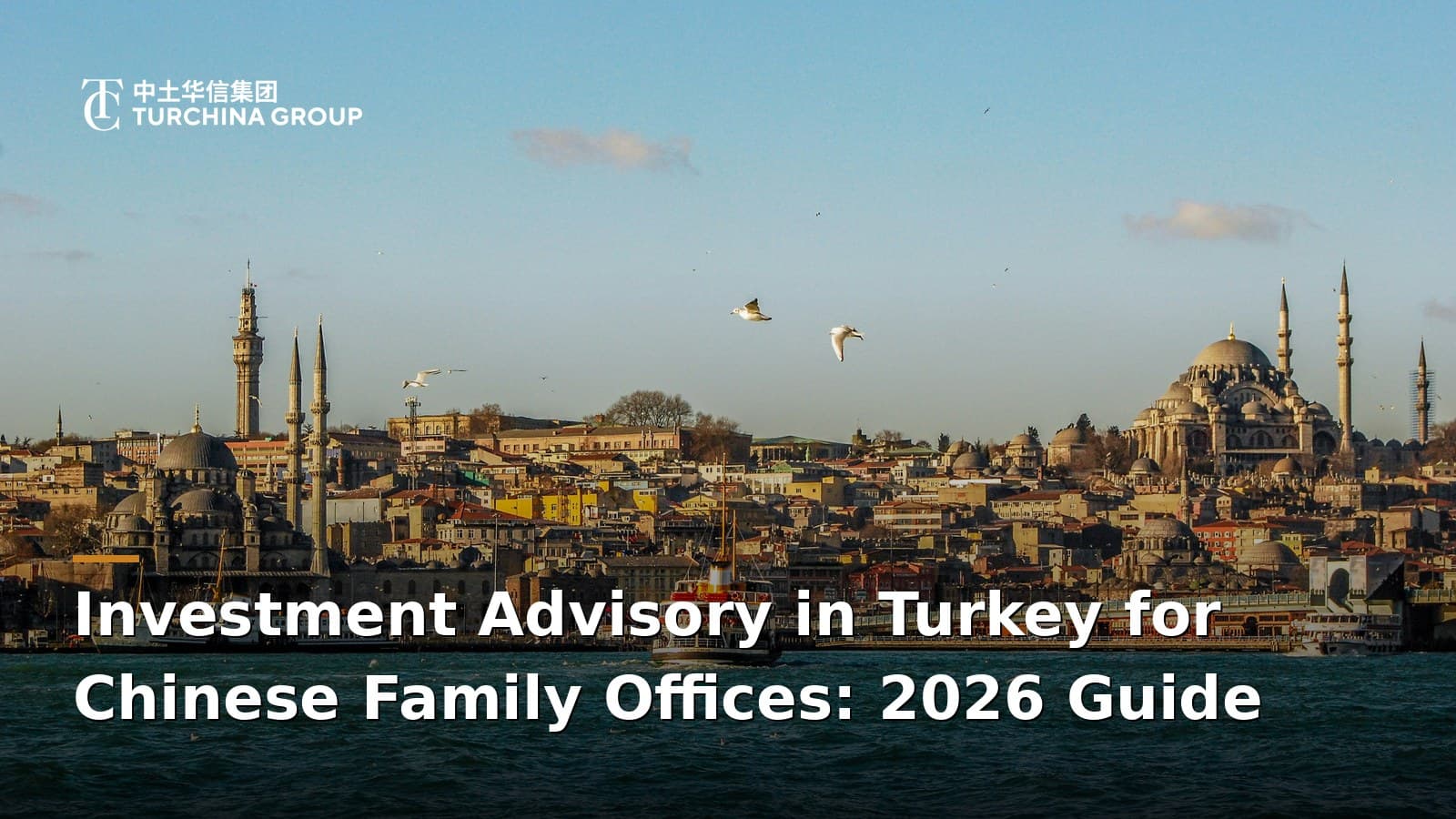
If you are looking for an under-the-radar market that can solve two problems at once, identity and assets, Turkey deserves a serious look. Good investment advisory in Turkey is not about pitching you a few apartments. It connects market strategy, sector research, independent due diligence, and execution so a family office can actually act on the opportunity. We are a cross-border advisory team headquartered in Istanbul with a fully Mandarin-speaking team. Below we lay out the questions a Chinese family office should settle first.
Key Takeaways
- The threshold for Turkish citizenship by investment (as of the time this article is written) is a compliant property purchase of around USD 400,000, or a deposit or fund placement of around USD 500,000 in a Turkish bank, with the whole family included in one application.
- The value of investment advisory in Turkey is not in introducing deals; it is in running independent due diligence, controlling structure and tax, and staying accountable across both the Chinese and the Turkish systems.
- A Turkish passport can serve as one of the qualifying nationalities for a US E-2 investor visa, but the E-2 still requires a genuine, active investment and is never granted automatically.
- Moving family capital into Turkey requires planning for both China's foreign-exchange rules and Turkey's source-of-funds review, and the structure should be designed before the investment, not patched afterward.
- China does not recognise dual nationality, so if children are being positioned for the overseas Chinese student exam, they must genuinely meet the nationality and overseas-residency conditions; arranging status earlier keeps more options open.
Why Chinese Family Offices Are Studying Turkey
Turkey's appeal is that it stacks several goals into one market. It straddles Europe and Asia as a trade and manufacturing hub linking the EU, the Middle East, and Central Asia. Its currency has swung for years, which makes dollar-priced assets relatively attractive to incoming capital. And it offers a clear citizenship-by-investment route, so identity and assets can be planned together.
For a Chinese family office, financial return is rarely the only objective. The more common brief is to solve three things at once: asset diversification, a second identity for redundancy, and the next generation's education. Turkey touches all three. Property and funds give you allocation targets, citizenship by investment gives a second passport, and that passport in turn opens further paths such as the US E-2 visa and the overseas Chinese student exam for children. With so many dimensions in play, you need one genuinely cross-border advisor to coordinate, not a patchwork of separate agents, lawyers, and bankers.
What Investment Advisory in Turkey Actually Covers
Investment advisory in Turkey means translating a family's objectives into an executable investment and structuring plan, then owning the outcome. In practice it usually breaks into five parts.
- Market and sector research. Based on the family's risk appetite and time horizon, we judge whether to weight property, funds, operating businesses, or M&A, and provide research down to the specific city, district, and asset level, not vague generalities.
- Deal sourcing and matching. We screen for real targets across real estate, private funds, and operating companies, checking valuation, title, and cash flow. We take no developer commissions, so our position is independent.
- Due diligence. We independently verify a target's title, tax position, debts, compliance, and the seller's background. This is the step most agents skip when working with family offices.
- Structuring and tax design. We design how the holding vehicle, the citizenship path, and tax-residency status relate, so you do not discover an unfavourable structure after the deal closes.
- Execution and ongoing reporting. From account opening, transfer, and company formation to first-year compliance, we report progress in writing, in Chinese, against milestones.
Our Istanbul team works in Mandarin throughout and plugs into local Turkish accounting, valuation, and legal resources, so a family office is not constantly translating between two systems.
Where Family Offices Invest in Turkey
A family office in Turkey rarely makes one concentrated bet. Allocation is layered by objective. The table below compares the main routes so you can place yourself quickly.
| Route | Typical threshold (as written) | Main objective | Watch closely |
|---|---|---|---|
| Citizenship property | Around USD 400,000 | Identity plus real estate | Valuation compliance, three-year hold |
| Pure financial property | Flexible | Rent and appreciation | Location, currency, liquidity |
| Fund or deposit citizenship | Around USD 500,000 | Identity plus financial assets | Fund eligibility, redemption terms |
| Operating company or M&A | Deal-dependent | Industrial entry, synergy | Business diligence, local team |
These thresholds and holding periods reflect the rules as of the time this article is written. Turkey has adjusted its citizenship-by-investment amounts and conditions several times in recent years, so confirm the current standard with an advisor before acting.
Citizenship by Investment and Real Estate
Turkish citizenship by investment is the route Chinese families ask about most. The mainstream method, as written, is a compliant property purchase of around USD 400,000, with the whole family (spouse and minor children) included in one application. The property must satisfy the General Directorate of Land Registry (Tapu) and the official valuation system, and there is a restriction against selling within three years. Tying citizenship to a property allocation is the classic family-office move of putting one sum of money to two uses, but only if the valuation and title can withstand scrutiny. You can read more on our citizenship by investment service.
Funds, M&A, and Operating Businesses
A family office that does not want to hold property can take the roughly USD 500,000 compliant deposit or fund route to the same identity. One that wants industrial synergy may instead go straight into acquiring or partnering with an operating company. Our M&A and corporate advisory service runs business diligence on the target rather than reading a single set of statements.
Tying Identity Planning to the Investment
Treating the investment and the identity as two separate projects is the trap Chinese family offices fall into most often. Turkey's value is that the two can be designed together from the start.
A Turkish passport makes family members eligible to apply for a US E-2 investor visa as Turkish nationals. The E-2 is not a free add-on to the passport. The applicant still has to make a genuine, non-marginal investment in the United States and be actively involved in running it, and approval rests with the discretion of the US consular officer, with no guaranteed result. Describing Turkish citizenship as one of the prerequisites for the E-2 is accurate. Describing it as "get the passport and you can go to America" is misleading.
For families with minor children, a second identity also bears on planning for the overseas Chinese student exam (华侨生联考). That path requires the child to genuinely hold the qualifying foreign nationality or overseas-residency status, and parents to meet the corresponding overseas-residency duration. Because China does not recognise dual nationality, this has real consequences for a child's school registration, social insurance, and inheritance. Our consistent advice is that the earlier you arrange status, the more options you keep later, but any plan has to rest on genuinely meeting the conditions. It is never a shortcut.
Due Diligence, Compliance, and Tax
Family offices require far more demanding diligence and structuring than individual investors. Strong investment advisory in Turkey finishes several things before a deal closes.
- Title and valuation checks. Confirm through the Tapu and the official valuation system that title is clean and the valuation is compliant, so you do not buy an overvalued asset or one with a defective title.
- Source of funds and anti-money-laundering. Turkish banks and regulators review the source of funds, so the structure and documents need to be prepared in full ahead of time.
- Tax residency. Whether the investment triggers Turkish tax residency, and how that coordinates with Chinese tax residency, should be modelled before investing, not repaired afterward.
- Cross-border legal coordination. Where contracts, disputes, or inheritance are involved, qualified counsel in both China and Turkey need to work together. Our cross-border legal advisory is an advisory bridge between the two systems, not single-jurisdiction law-firm representation.
The Real Question of Moving Capital Across Borders
How capital moves compliantly from China into Turkey is something a family office must solve before execution. Most agents gloss over this question. China operates foreign-exchange controls, and cross-border arrangements for both individuals and companies follow specific rules. On the Turkish side there is source-of-funds and anti-money-laundering review. Both ends need to be designed together at the investment-decision stage: where the holding vehicle sits, in what form money enters, and how dividends and exit will work later.
We do not provide, and we do not advise, any arrangement that evades regulation. What we can do is help you plan the structure, timing, and documents in advance within a compliant framework, reducing uncertainty at the moment capital actually needs to land. This part typically requires our investment advisory team to work alongside cross-border legal and tax resources.
How Investment Advisory in Turkey Works in Practice
A complete project usually runs in four steps, each reported in writing, in Chinese.
- Diagnosis and strategy. Clarify the family's objectives, time horizon, and risk appetite, then propose a Turkish-market allocation and an initial structure.
- Diligence and selection. Screen specific targets and complete independent checks on title, tax, compliance, and operations.
- Execution. Account opening, transfer or company formation, the citizenship application, and the capital arrangement, advanced against milestones.
- Ongoing management. Compliance, tax filing, renewals, and exit planning across the asset's holding period.
As an independent provider of investment advisory in Turkey, we take no developer commissions and stay transparent about price, taxes, fees, and risk. Family offices tell us they value that independence above everything else.
Frequently Asked Questions
What is the difference between a family-office investment advisor and an ordinary property agent?
Alignment and scope. An ordinary agent earns developer commissions and is motivated to close a single transaction, while a family-office investment advisor is accountable to the family's overall objectives across strategy, independent due diligence, structuring and tax, execution, and ongoing reporting. We take no developer commissions, which keeps us independent.
How much does a Chinese family office need to invest in Turkey?
The amount depends on the objective, not a single fixed floor. If citizenship is the goal, the property route is around USD 400,000 and the deposit or fund route around USD 500,000 as of the time this article is written, while pure financial property or fund allocations are more flexible, and M&A or operating investments are deal-dependent. The amounts and rules can change, so confirm the current standard before acting.
Does a Turkish passport let me go to the United States?
Not automatically. A Turkish passport is one of the qualifying nationalities for a US E-2 investor visa, but it does not grant access on its own. The E-2 still requires a genuine, non-marginal investment in the United States and active involvement in running it, and it is granted at the discretion of a US consular officer with no guaranteed outcome. Treating Turkish citizenship as one of the prerequisites for the E-2 is accurate.
How does capital move compliantly from China into Turkey?
Capital flow must be planned at the investment-decision stage around both China's foreign-exchange rules and Turkey's source-of-funds review. We do not provide any arrangement that evades regulation; what we do is help you design the holding vehicle, the form of entry, and the exit path in advance within a compliant framework to reduce uncertainty when capital lands.
Will investing in Turkey help my child with the overseas Chinese student exam?
Potentially, but only if the child genuinely holds the required foreign nationality or overseas-residency status and the parents meet the overseas-residency duration. Because China does not recognise dual nationality, this carries real consequences for school registration, social insurance, and inheritance. Planning status earlier keeps more options open, but it is never a guaranteed shortcut to admission.
Can the citizenship property be sold later?
Yes, but a minimum holding period applies. As of the time this article is written, property bought through citizenship by investment must be held for three years before it can be sold, and selling earlier may affect citizenship eligibility. That period is a policy rule and may change, so confirm the current requirement with an advisor before buying.
How long does the whole process take?
The timeline varies by route and case, measured in months rather than weeks. Property transfer, bank account opening, the capital arrangement, and the citizenship application each move at their own pace and depend on official processing times. We give an estimate based on current conditions at the start of a project and update it against milestones.
What is your relationship with local Turkish lawyers and accountants?
We coordinate: we translate the family's objectives into a plan and engage local resources accordingly. We work alongside Turkish valuation, accounting, and legal professionals, and cross-border legal matters are handled by qualified counsel in both China and Turkey. We are a cross-border advisory firm, not a single-jurisdiction law firm.
If you are planning a Turkey allocation for your family, independent, cross-border, Mandarin-speaking investment advisory in Turkey can connect strategy, diligence, and execution into one coherent process. Book a free consultation in Mandarin or English, and our Istanbul team will give you advice based on current policy and your specific situation.
Disclaimer: This article is for general informational purposes only and does not constitute legal, tax, immigration, or investment advice. Policies and figures change; please confirm the current details and your personal eligibility with a qualified advisor before acting.