20 June 2026 · Turchina Group · 10 min read
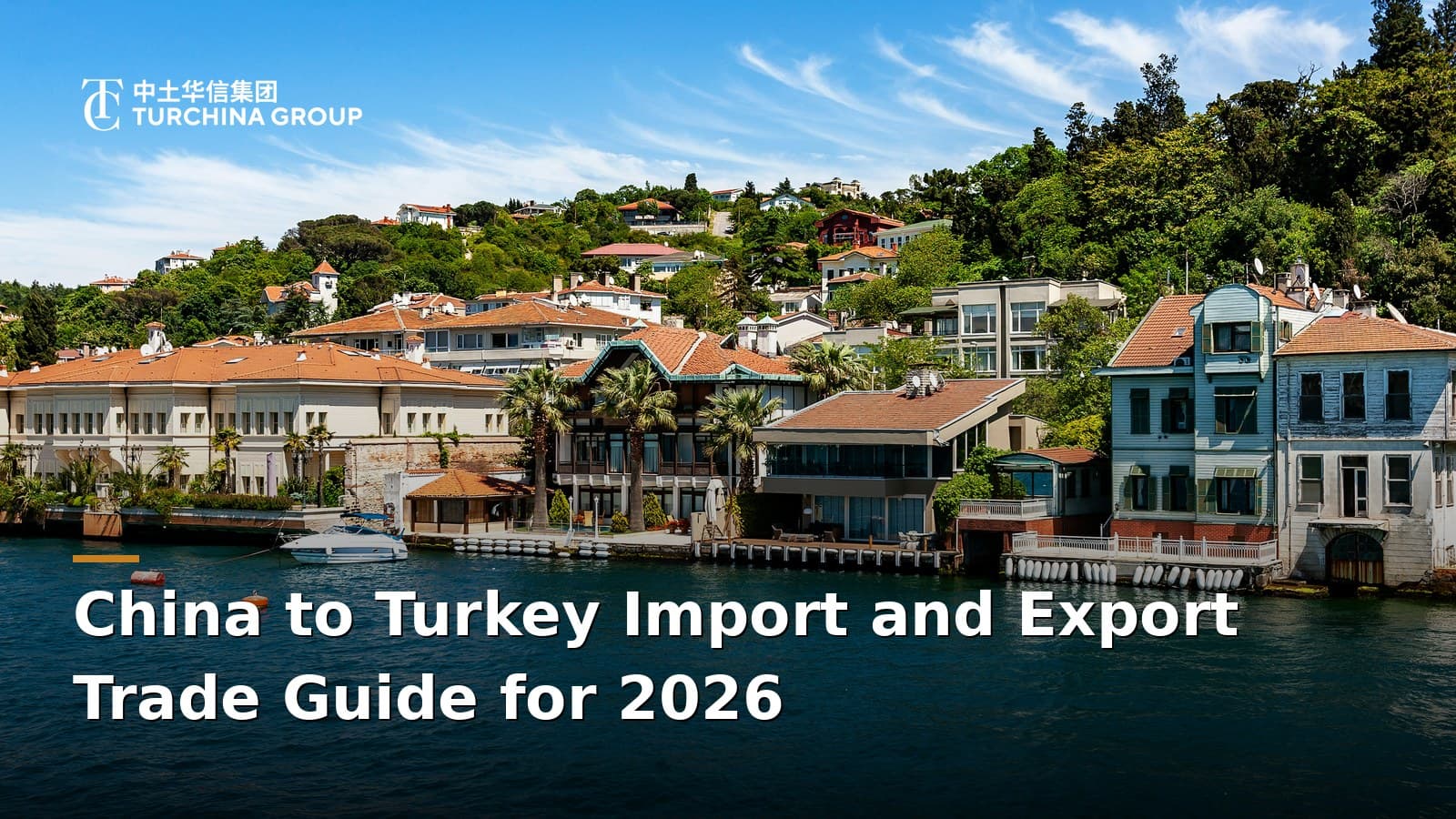
China to Turkey Import and Export Trade Guide for 2026
China to Turkey import and export in 2026: a practical guide to HS codes, customs duties, clearance documents, settlement options, and bonded warehousing for Chinese businesses entering the Turkish market.
If you are planning China to Turkey import and export operations in 2026, the answer to "how do I get goods into Turkey smoothly and at a controlled cost" comes down to three things: the correct HS code and applicable duty rate for your product, a complete and internally consistent set of customs documents, and a workable arrangement for collecting payment and issuing invoices on the Turkish side. Getting these right before the cargo leaves China will save you far more trouble than searching for the cheapest freight forwarder. Our Mandarin-speaking team in Istanbul handles these cases daily, and this guide walks through the full chain in the order you actually need to act on it.
How China to Turkey Import and Export Works
The China to Turkey import and export process runs in six linked stages: classify your goods and confirm the applicable duty rate, sign a trade contract and agree on Incoterms (FOB, CIF, DAP, and so on), arrange transport, prepare the full document set, clear customs at a Turkish port, and then complete local delivery and payment settlement.
There is no free trade agreement between China and Turkey, so Chinese-origin goods enter at Turkey's Most Favoured Nation (MFN) tariff rate for third countries. Some product categories also attract anti-dumping duties or additional levies. This surprises many clients who assume a more favourable rate, and discovering the real duty position after the cargo has already sailed is an expensive way to learn. Checking the tariff schedule before you place the order eliminates that risk entirely.
By sea, the main gateway ports near Istanbul are Ambarlı and, on the Mediterranean coast, Mersin. Transit time from major Chinese ports runs around three to five weeks as of the time this article is written, depending on the shipping line, the season, and whether any transshipment is involved.
HS Codes and Customs Duties for China to Turkey Import and Export
Classifying your goods under the correct HS code is the single most consequential step in the whole China to Turkey import and export process. Turkey uses a 12-digit customs tariff code aligned with the international Harmonised System; the first six digits match the Chinese HS code, while the remaining digits reflect Turkey's own sub-classification. A mis-classification can result in amended-document requests, port demurrage costs, or, in more serious cases, a finding of mis-declaration.
Import costs into Turkey typically consist of three layers:
- Import duty (Gümrük Vergisi): applied at the MFN rate, ranging from zero percent to higher figures depending on the product category.
- Import VAT (KDV): Turkey's standard rate as of the time this article is written is 20 percent, with reduced rates of 10 percent or 1 percent for certain goods, calculated on the customs value plus duty.
- Additional charges: these may include Special Consumption Tax (ÖTV, covering vehicles, tobacco, alcohol, and fuel), anti-dumping duties on specific Chinese product lines, and the Resource Utilisation Support Fund (KKDF) levy.
Rates and additional measures change with policy updates. Confirm the current rates for your specific product with an advisor before committing to a shipment. Our team can run a classification and landed-cost calculation so you know the full cost before the goods move.
Documents Required for China to Turkey Import Customs Clearance
Clearing goods through Turkish customs requires a complete and mutually consistent set of documents. The four core documents are the commercial invoice, the packing list, the bill of lading (or airway bill for air shipments), and the certificate of origin.
Depending on the product category, you may also need:
- Certificate of Origin: proving Chinese origin and establishing which duty rate applies, including whether anti-dumping measures are triggered.
- CE marking or TSE (Turkish Standards Institute) certification: mandatory for electronics, machinery, toys, construction materials, and other regulated goods.
- Health or phytosanitary certificate: required for food products, agricultural goods, and cosmetics, issued in coordination with Turkey's Ministry of Agriculture and Forestry or the Ministry of Health.
- Pre-shipment inspection: some product categories require an inspection in China before the goods leave.
Every field on every document, including product description, quantity, declared value, weight, and consignee name, must be identical across the invoice, the packing list, and the bill of lading. Discrepancies are the most frequent cause of goods being held at port. Whether the inconsistency is a currency mismatch on the invoice, a different consignee spelling, or an HS code that does not agree with the goods description, the outcome is the same: delays and extra costs. Our Istanbul team reviews the full document set before loading to catch these problems before they become demurrage bills.
Payment Settlement and Currency Options for China to Turkey Trade
Settlement is one of the most underestimated elements of China to Turkey import and export. The Turkish lira (TRY) carries meaningful exchange rate volatility, and Turkey has specific regulatory requirements governing cross-border payments. The choice of settlement method and currency directly affects your margin and collection security.
Common settlement methods include telegraphic transfer (T/T), letters of credit (L/C), and documentary collections (D/P or D/A). For new counterparties or large orders, a letter of credit or a partial advance combined with balance on delivery generally offers the best protection for both sides. For ongoing, established relationships, T/T with a modest deposit works once trust and track record are built.
Most China-Turkey transactions settle in US dollars or euros to avoid direct exposure to lira fluctuations. If you plan to sell locally in Turkey and collect in lira, you will need a Turkish company account to receive payments lawfully, issue Fatura (official Turkish tax invoices), and account for VAT on local sales.
Where trade volume has stabilised, establishing a local entity in Turkey usually lowers costs and simplifies the VAT deduction chain compared with relying long-term on a third-party agent.
Choosing Between Sea, Air, and Rail Freight
Sea freight is the lowest-cost option and the backbone of China to Turkey trade; air freight is fast but expensive; rail via the Trans-Caspian route offers an intermediate option. The choice depends on the balance between cargo value, time sensitivity, and volume. Sea is best suited to bulk cargo and heavy goods. Air is best reserved for high-value goods, urgent replenishment, or samples. Rail via the Trans-Caspian route or through the Russia-Georgia corridor is gaining ground, and a growing number of clients are factoring it into their logistics planning.
After arrival, goods can be cleared directly for local delivery or placed in a bonded warehouse (Antrepo) for deferred customs entry. A bonded warehouse lets you delay the payment of import duty and VAT, clear goods in batches, and manage stock more flexibly. This suits clients who are distributing across Turkey or re-exporting to neighbouring markets.
Turkey's position at the junction of Europe and Asia, combined with its Customs Union with the EU, has led many Chinese companies to treat it as a staging and light-assembly base for goods destined for European, Middle Eastern, and North African markets. Thinking through warehousing and clearance structure at the planning stage can make this geography work in your favour.
Setting Up a Local Entity in Turkey for Trade
Registering a Turkish company gives you direct control over importing, VAT recovery, invoicing, and local hiring. Whether to register depends on your trade model and longer-term plans. For one or two occasional shipments, working through a Turkish importer or customs agent who clears goods in their name is perfectly viable. For continuous importing, building your own distribution channel, issuing invoices locally, or hiring Turkish staff, a Turkish limited liability company (LLC) is typically the more efficient and compliant structure. With a local entity, you can import in your own name, reclaim import VAT against output VAT, sign local contracts directly, and employ people. The setup process generally covers company incorporation, obtaining a tax identification number, opening a business bank account, and filing the first year of compliance returns. We provide company registration in Turkey and import and export trade consulting as an integrated service, with our Istanbul-based Mandarin-speaking team coordinating with Turkish customs, tax authorities, and banks at each stage, and reporting back to you in Chinese at every milestone.
Common Risks in China to Turkey Import and Export and How to Manage Them
Classification errors, document mismatches, currency exposure, and product-compliance failures are the four most common problems in China to Turkey import and export operations. Of these, mis-declaration and document mismatches cause the most delays and fines in practice, and they are also the most preventable with good preparation.
Practical steps that reduce risk: confirm the HS code and any certification requirements before production begins; make sure the invoice, packing list, and bill of lading are fully consistent; use a letter of credit or advance payment in dollars or euros for large or unfamiliar transactions; secure CE, TSE, or health certificates well before loading for regulated products; and check the latest anti-dumping and additional-levy schedules for your specific product. Policy, tariff rates, and regulated-product lists are updated periodically, so confirming the current position for your goods before each shipment is a sound practice. Any specific decision should be made after consulting an advisor on the current rules and your individual circumstances.
Frequently Asked Questions
What import duties apply to goods shipped from China to Turkey?
Chinese goods entering Turkey are generally subject to import duty at the MFN rate, import VAT at Turkey's standard 20 percent rate (with reduced rates of 10 percent or 1 percent for certain categories), and potentially Special Consumption Tax, anti-dumping duties, or other surcharges depending on the product. The total is calculated on the customs value (CIF basis), and the rates as of the time this article is written should be confirmed against the current Turkish tariff schedule before you ship.
How long does sea freight from China to Turkey take?
Sea freight from major Chinese ports to Turkey typically takes around three to five weeks, depending on the shipping line, the transshipment port, and the season. Air freight usually arrives within a few days but at significantly higher cost. Rail via the Trans-Caspian corridor offers an intermediate option on both transit time and cost.
What documents are required for Turkey customs clearance?
The four essential documents for Turkey customs clearance are the commercial invoice, the packing list, the bill of lading (or airway bill), and the certificate of origin. Regulated product categories require additional paperwork such as CE or TSE certification, health certificates, or phytosanitary permits. All documents must be fully consistent: any mismatch in product description, quantity, declared value, or consignee name can cause the goods to be held at port.
Can I import into Turkey without a Turkish company?
Yes, but with limitations. Without a Turkish legal entity, you typically need to work through a local Turkish importer or customs agent who clears goods in their own name. You cannot directly reclaim import VAT, and issuing official Turkish tax invoices for local sales becomes more complicated. For consistent, high-volume trade or for building a local distribution channel, registering a Turkish company gives you more control and is generally the more efficient long-term structure.
Which currency and payment method is safest for China-Turkey trade?
Most China-Turkey transactions settle in US dollars or euros to avoid lira exchange rate exposure. For new business relationships or large orders, a letter of credit or a partial advance payment combined with balance on delivery provides the most protection for both sides. Established, long-running relationships can move toward T/T once sufficient trust and track record are in place.
Can Turkey serve as a gateway to European markets?
Turkey has a Customs Union with the EU and sits at the junction of Europe, Asia, and the Middle East, making it a practical base for distribution, light assembly, or re-export toward European, Middle Eastern, and North African markets. Bonded warehouse structures and a local Turkish entity can help optimise the customs and tax position for this kind of hub strategy, though the right approach depends on your product and target markets.
What is a bonded warehouse in Turkey and when does it make sense?
A bonded warehouse (Antrepo) is a customs-supervised facility where imported goods can be held without paying duty or VAT until they are formally cleared for local consumption. This is useful for clients who want to distribute goods in batches, improve cash flow flexibility, or re-export to neighbouring markets without incurring full Turkish import costs. Whether it suits your operation depends on cargo volume and your sales cadence.
Do Chinese goods face anti-dumping duties in Turkey?
Some Chinese product categories, including certain steel, textile, chemical, and consumer goods lines, are subject to anti-dumping duties or additional tariff measures in Turkey. Whether a specific product is affected depends on its HS code and declared origin, and the relevant lists are reviewed and updated periodically. Checking whether your product falls under any current measures before shipment is an important step in calculating the true landed cost.
If you are ready to start or scale China to Turkey import and export operations, our team can take you from product classification and duty calculation through customs clearance, settlement, and local entity setup as a single managed process. Book a free consultation in Mandarin or English, and our Istanbul-based Mandarin-speaking team will work through your supply chain from end to end.
Disclaimer: This article is for general informational purposes only and does not constitute legal, tax, immigration, or investment advice. Policies and figures change; please confirm the current details and your personal eligibility with a qualified advisor before acting.